HIFU results: the short answer
If you are researching HIFU results how long, the key thing to know is that results are gradual rather than instant. Some people notice a mild tightening effect immediately after treatment because ultrasound heat causes initial tissue contraction. However, the more meaningful change happens over the following weeks and months as your body produces new collagen.
In most cases, around 40% of the visible improvement is noticeable by the one-month mark, with the best results typically developing between 3 and 6 months. Longevity varies from person to person, but many patients keep their improvement for around 6 to 18 months, and some may see benefits lasting closer to 2 years depending on age, skin quality, lifestyle, and maintenance.
At VIVO Body Studio, the UK’s leading group of non-invasive aesthetic clinics, practitioners set expectations carefully: HIFU can create noticeable tightening and lifting, but it is not a replacement for a surgical facelift. If you are considering HIFU facelift and body tightening, understanding the timeline helps you judge your outcome realistically.
What HIFU actually does
High-Intensity Focused Ultrasound delivers focused ultrasound energy into targeted layers of tissue. This controlled thermal effect stimulates collagen remodelling over time. Clinical literature on microfocused ultrasound supports the idea that collagen regeneration continues for several months after treatment, which is why the results timeline is progressive rather than immediate. The treatment is widely used for non-surgical lifting and tightening in areas such as the lower face, jawline, cheeks, brow, and neck.
If you are comparing technologies, our guide to HIFU vs Ultherapy explains how related ultrasound-based approaches differ in practice.

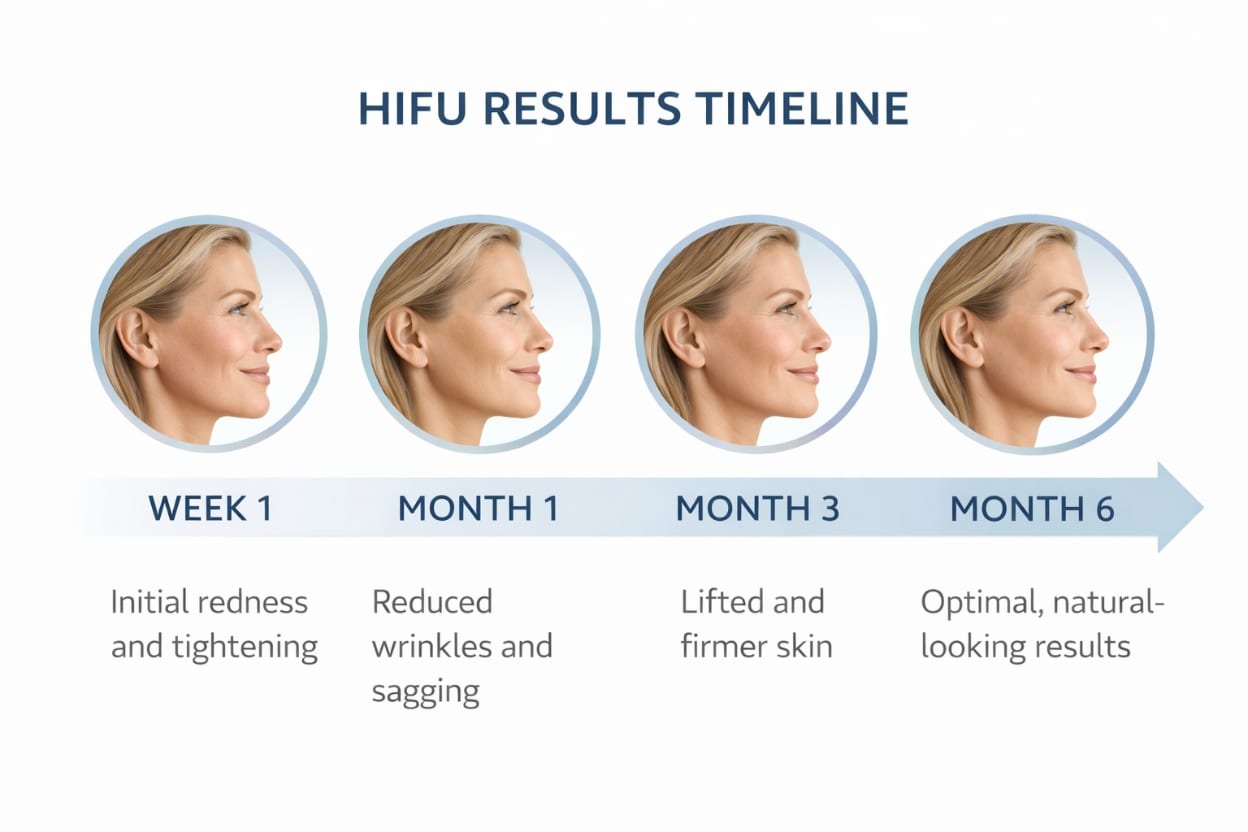
HIFU changes tend to build gradually, with peak improvement usually appearing months after treatment.
When do HIFU results show?
One of the most common questions is: when do HIFU results show? The answer depends on whether you mean the earliest visible change or the final outcome.
Immediately after treatment
Some patients notice a slight firming effect straight away. This is usually subtle and linked to the immediate response of the treated tissue to heat. It can make the skin feel a little tighter, but it is not the full result.
Weeks 2 to 4
Over the first few weeks, you may start to see small changes in skin firmness and texture. This stage is often quite modest. Friends and family may not notice much yet, but you may feel that your face looks a little fresher or more supported.
At 1 month
By about four weeks, many people can see a clearer improvement. A useful rule of thumb is that around 40% of the final result may be visible at this point. The jawline can begin to look neater, and the skin may seem slightly firmer around the lower face and neck.
At 2 to 3 months
This is often the point where HIFU becomes more obvious. The HIFU facelift results timeline usually shows visible lifting and tightening here, particularly around the jowls, brow area, and upper neck. Guidance from the American Board of Cosmetic Surgery also notes that ultrasound tightening commonly shows positive results in 2 to 3 months.
At 3 to 6 months
For many people, this is the peak window. Collagen production and maturation continue, so the full effect may not be clear until month 4, 5, or 6. Studies on ultrasound-based skin tightening indicate that neocollagenesis and tissue remodelling are ongoing processes rather than a single-event change, which is why patience matters when assessing your final outcome.
A simple HIFU timeline at a glance
| Time after treatment | What you may notice |
|---|---|
| Immediately to 1 week | Possible mild tightening, subtle firmness |
| 2 to 4 weeks | Early texture and firmness improvements |
| 1 month | Roughly 40% of visible improvement may be apparent |
| 2 to 3 months | More noticeable lifting and contour definition |
| 3 to 6 months | Peak collagen remodelling and best overall results |
If you like seeing visual timelines for aesthetic treatments, you may also find our article on non-surgical facelift options helpful when deciding how HIFU compares with other approaches.
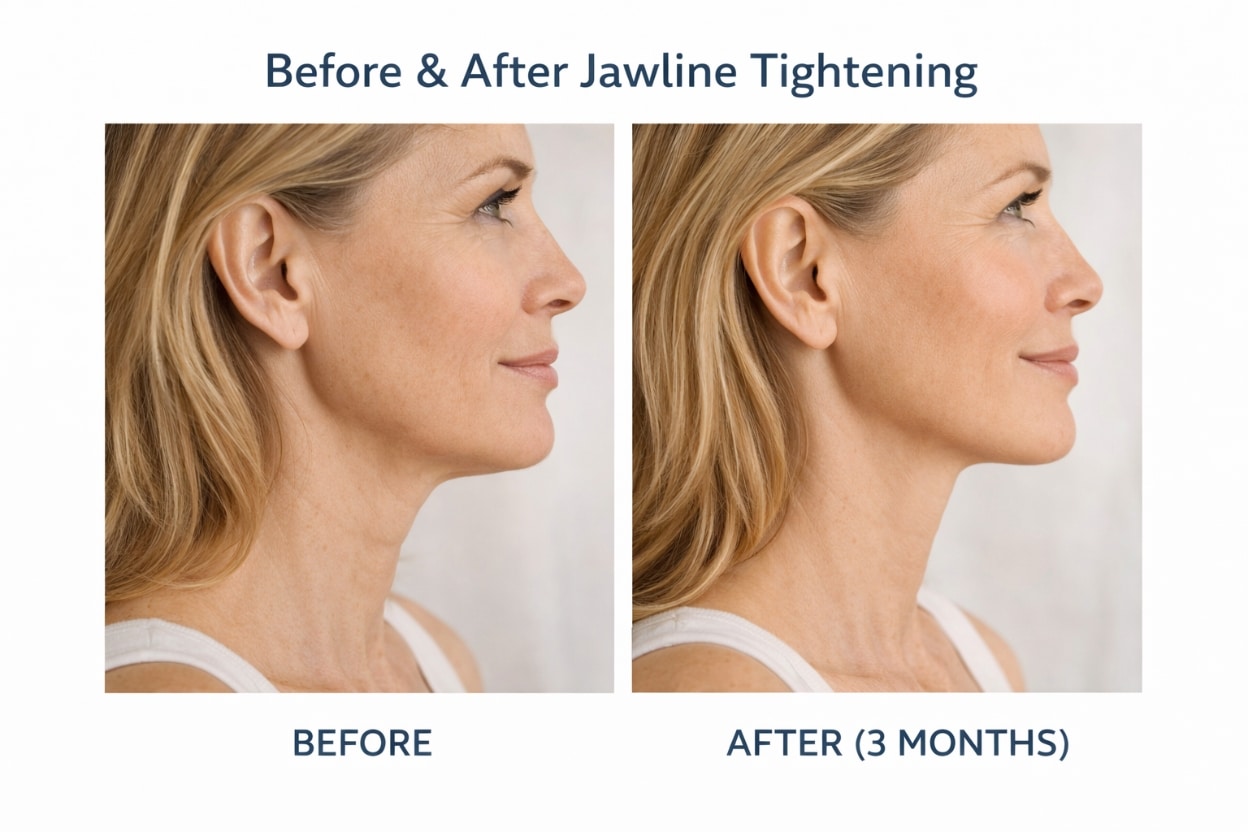
Most patients describe HIFU improvements as gradual, natural-looking firming rather than a dramatic overnight change.
What HIFU can and cannot realistically do
Benefits
- Can create visible lifting and tightening without surgery
- Results develop naturally as collagen production increases over time
- Often improves areas such as the jawline, lower face, brow and neck
- Minimal downtime for most patients compared with invasive procedures
- Results may last 6 to 18 months or longer in suitable candidates
Considerations
- Not a replacement for a surgical facelift in advanced skin laxity
- Results are gradual, so it is not ideal if you want an instant change
- Longevity varies widely depending on age, skin quality and lifestyle
- Some patients need maintenance or repeat sessions for best outcomes
- People with significant laxity may achieve only modest improvement
How long does HIFU last?
When people ask how long does HIFU last, the most honest answer is that there is a range rather than a single figure. Most published estimates and clinic experience place HIFU longevity at around 12 to 18 months on average, though some people notice gradual fading sooner and others maintain benefits for up to 2 years.
A practical way to think about it is this:
- 6 to 9 months: a shorter duration, often seen where ageing is more advanced or lifestyle factors are less favourable
- 12 to 18 months: a common real-world range for many patients
- Up to 24 months: possible in selected patients with good skin quality, healthy habits and timely maintenance
Research and professional commentary consistently suggest that ultrasound tightening can remain visible for many months, but because the natural ageing process continues, results do not stay frozen in place. Your skin keeps ageing, collagen naturally breaks down over time, and sun exposure or smoking can accelerate that process. This is why many clinics recommend a maintenance session every 9 to 12 months, while some individuals benefit from annual top-ups.
Patients in their 30s and 40s often see some of the longest-lasting improvements because their collagen-producing ability is usually stronger than in older age groups. That does not mean HIFU stops working later in life, but the degree and duration of improvement can be more modest where skin laxity is more established.
Does the treatment area matter?
Yes. Small areas such as under the chin may respond differently from the lower face or neck, and body areas may have their own timeline. Facial HIFU usually gets the most attention because subtle lifting around the brow, cheeks and jawline is easier to monitor closely in the mirror. During consultation, a practitioner should assess not just your age, but your skin thickness, degree of laxity, and whether one or two sessions may be more appropriate.
What do realistic before and after results look like?
Good HIFU before and after images typically show cleaner jawline definition, reduced heaviness in the lower face, a slightly lifted brow or firmer-looking neck. The best examples look natural rather than overdone. If you want to see how outcomes compare with another non-surgical skin tightening option, our page on Morpheus8 skin tightening treatment can help you understand where HIFU sits in the wider treatment landscape.
The best HIFU results are usually the ones that look as though you have simply aged more slowly, not as though you have had something obvious done.
What affects your HIFU outcome?
Not everyone gets the same degree of tightening or the same duration of benefit. Several factors shape both how quickly you see change and how long it lasts.
1. Age
Age is one of the biggest variables. In general, patients in their 30s and 40s with mild to moderate laxity tend to respond best and keep results for longer. This is largely because collagen regeneration tends to be more efficient earlier in the ageing process. People over 50 can still benefit, but expectations should be grounded. If laxity is significant, the result may be improvement rather than transformation.
2. Baseline skin quality
Skin that still has reasonable elasticity usually responds better than skin with advanced sagging, heavy volume loss, or severe sun damage. If your starting point is stronger, the collagen stimulation produced by HIFU has more to work with.
3. Sun exposure history
Chronic UV damage is one of the main drivers of collagen breakdown. The NHS is clear that ultraviolet exposure contributes to premature skin ageing, which is one reason daily sun protection matters so much for maintaining cosmetic results. Using broad-spectrum SPF consistently can help preserve the collagen you already have, as well as the improvements stimulated by treatment. See NHS sun safety guidance for practical advice.
4. Smoking
Smoking is strongly associated with accelerated skin ageing and impaired wound healing. Although HIFU does not involve surgical incisions, smoking still works against collagen quality and tissue repair. If you smoke, you may find both the intensity and the longevity of your result are reduced.
5. Skincare routine
Good skincare will not replace treatment, but it can support your outcome. A routine built around daily SPF, antioxidant protection such as vitamin C, and collagen-supporting ingredients such as retinoids may help extend visible benefits. If your skin tolerates them, these ingredients often make sense as part of a long-term maintenance plan.
6. Hydration and general health
Hydration, sleep, nutrition, stress levels, and general health all influence how well your skin functions. While there is no miracle lifestyle formula, people who look after themselves generally give their skin a better environment for repair and collagen maintenance.
7. Treatment planning and practitioner skill
The treatment itself matters. Appropriate candidate selection, correct energy settings, and a well-designed treatment plan all influence results. In some cases, especially where laxity is more advanced, two sessions spaced several months apart may be recommended. A proper assessment is essential before treatment begins.
Who is usually a good candidate?
HIFU is often best suited to those with mild to moderate laxity who want a non-surgical option and are comfortable waiting for gradual improvement. If your main concern is more severe heaviness or loose skin, a practitioner may discuss alternative or combined options. For example, some patients compare HIFU with plasma eye lift for delicate upper-face concerns, or explore other tightening technologies depending on the area being treated.
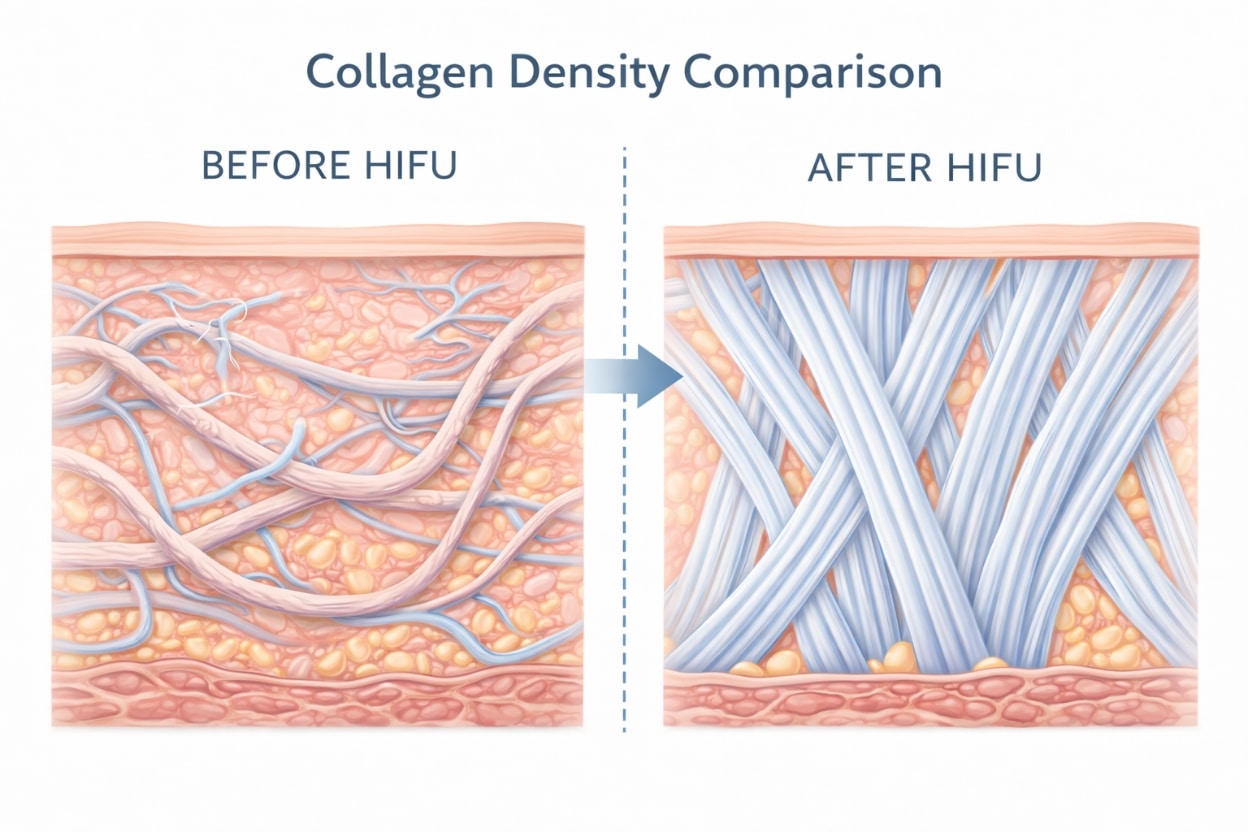
HIFU relies on collagen remodelling, which is why the final result takes time to emerge.
HIFU is a collagen-stimulation treatment first and an instant-results treatment second; patience is part of the process.
How to make HIFU results last longer
If you want the best possible return on your treatment, aftercare and maintenance matter. While no routine can stop ageing altogether, these habits can help support your result.
Use SPF every day
If there is one habit that consistently protects collagen, it is daily sun protection. UV exposure breaks down collagen and elastin, making skin look looser and older more quickly. Apply a broad-spectrum SPF every morning, even on cloudy days.
Follow a consistent skincare routine
A simple, evidence-informed routine is often more useful than an expensive, complicated one. Cleanse gently, moisturise well, and consider active ingredients such as retinol and vitamin C if suitable for your skin. If your barrier is sensitive, a practitioner can help you build up gradually.
Stay hydrated and support your general health
Hydration, good sleep, protein intake, and not smoking all help maintain skin quality. Regular exercise and sensible alcohol intake can also support overall wellbeing, which tends to show in the skin over time.
Attend maintenance appointments
Many patients keep their HIFU result looking fresher with an annual top-up. Depending on your age, treatment area and skin laxity, your practitioner may suggest maintenance every 9 to 12 months. This does not mean the treatment has failed; it reflects the reality that skin continues to age.
Have realistic expectations from the start
Perhaps the most overlooked factor in satisfaction is expectation-setting. If you expect surgical-level lifting from one non-invasive session, you are likely to feel disappointed. If you want a more natural improvement in firmness and contour with minimal downtime, HIFU may be an excellent fit.
If you are still weighing up your options, VIVO’s guide to non-surgical facelift treatments can help you understand where HIFU sits among other approaches. You can also review clinic imagery and set expectations by browsing VIVO’s results resources before booking.
Evidence and safety perspective
As with any aesthetic treatment, HIFU should be provided only after a proper consultation and skin assessment. Evidence in peer-reviewed literature supports microfocused ultrasound for non-invasive lifting and tightening in suitable patients, including published data on brow, submental and neck improvement over time. For a broader scientific overview of collagen remodelling after energy-based procedures, see peer-reviewed discussions on dermal remodelling and clinical studies of ultrasound skin tightening.
Book your HIFU consultation at VIVO. Our practitioners will assess your skin and set realistic expectations for your results.
Frequently Asked Questions
How long do HIFU results really last?
For many patients, HIFU results last around 6 to 18 months, with 12 to 18 months being a common expectation. Some people maintain improvement for closer to 2 years, especially if they have mild laxity, good skin quality, healthy habits, and regular maintenance. The exact duration depends on age, sun exposure, smoking status, skincare, overall health, and how your body responds to collagen stimulation.
When will I see HIFU results?
You may notice a small tightening effect immediately after treatment, but this is not the final result. Early changes often begin within 2 to 4 weeks. By about 1 month, some patients can see around 40% of their eventual improvement. More obvious lifting and tightening usually show at 2 to 3 months, with peak results commonly seen between 3 and 6 months.
Does HIFU work after 50?
Yes, HIFU can still work after 50, but results are often more modest than in younger patients with milder laxity. If your skin has reasonable elasticity, you may still see worthwhile firming and contour improvement. However, if skin laxity is advanced, a practitioner should explain that HIFU is unlikely to replicate surgical lifting. In some cases, a combination approach or repeat sessions may be recommended.
How often should you have HIFU?
Many clinics recommend a maintenance treatment every 9 to 12 months, though this varies according to age, treatment area and the severity of skin laxity. Some people benefit from annual top-ups, while others may need an earlier review. Your practitioner should base the plan on how your skin responds rather than using a one-size-fits-all schedule.
What can I do to make HIFU results last longer?
The most useful steps are wearing SPF daily, avoiding smoking, keeping skin well hydrated, following a consistent skincare routine, and attending maintenance sessions when advised. Ingredients such as retinol and vitamin C may support skin quality if appropriate for your skin type. Healthy lifestyle habits will not stop ageing, but they can help preserve the collagen and firmness gained from treatment.