What is fat freezing and why it has become so popular
If you have ever asked what is fat freezing, the short answer is this: it is a non-surgical body contouring treatment that uses controlled cooling to reduce small, localised areas of stubborn fat. The medical term is cryolipolysis. It is designed for people who are already close to their target weight but want help with bulges that tend to resist diet and exercise, such as the abdomen, flanks, thighs, upper arms or under the chin.
Interest in fat freezing has grown because many people want visible contouring without surgery, general anaesthetic or the recovery period linked to liposuction. Major medical sources including Cleveland Clinic and Harvard Health describe cryolipolysis as a cosmetic procedure for reducing localised fat rather than a treatment for obesity. That distinction matters. Fat freezing is about shaping, not significant weight loss.
The treatment is often associated with CoolSculpting, one of the best-known branded systems, but the broader science is the same. If you are comparing terminology, our guide to CoolSculpting vs cryolipolysis explains why the two are often discussed together.
At clinics such as VIVO Body Studio, the UK’s leading group of non-invasive aesthetic clinics with over 1500+ 5-star reviews, fat freezing is typically presented as one option within a wider body contouring plan. For some people, that may mean combining it with lifestyle changes; for others, it may involve comparing it with alternatives such as body contouring treatments like EMSCULPT or exploring a broader weight loss programme where overall body weight is the main concern.
In this article, we will look at how does fat freezing work, the science behind the process, what fat cell apoptosis means, whether the treatment genuinely works, and who is most suitable for it.


Cryolipolysis explained: the science behind fat freezing
Cryolipolysis explained simply means using carefully controlled cold exposure to injure fat cells more than surrounding tissues. Researchers observed that fat cells are more vulnerable to cold than skin, muscle and other nearby structures. This selective sensitivity is the foundation of the treatment.
The origin of the idea is often linked to the Harvard-led observation sometimes called the “popsicle” discovery. Children who sucked ice lollies developed temporary cheek dimples caused by cold-induced inflammation of fat, known as popsicle panniculitis. That observation helped inspire further research into whether local cooling could reduce fat safely. Early work by Dieter Manstein and R. Rox Anderson helped establish the mechanism, and later clinical studies supported its use in cosmetic medicine.
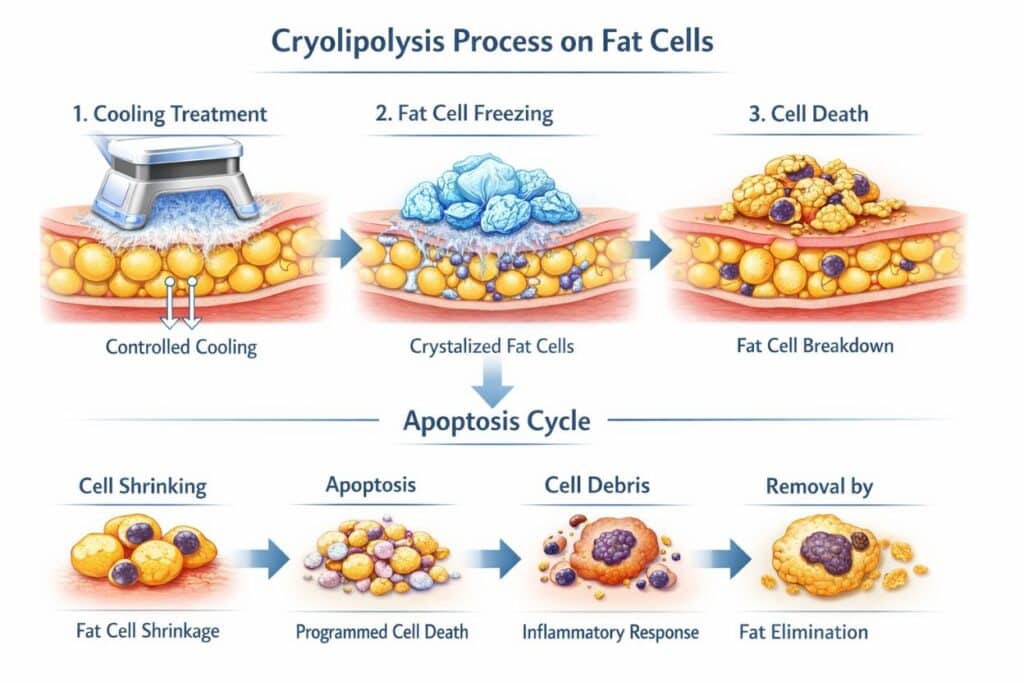
When people ask about the coolsculpting science, the key point is that fat freezing does not work by turning body fat into a solid block of ice. Instead, the cooling places fat cells under stress. The lipids inside adipocytes become susceptible to crystallisation and injury at temperatures that nearby tissues can tolerate better. This sets off a biological cascade that leads to apoptosis, or programmed cell death.
A frequently cited clinical review indexed on PubMed, PMID: 25548084, describes cryolipolysis as a safe and effective non-invasive procedure for localised fat reduction. Reviews and clinical publications have also reported measurable reductions in fat layer thickness after treatment, commonly around 20% to 25% per area after a single session, with some reports reaching up to 28% depending on the device, body area and study design.
Typical treatment temperatures are often described in the range of around 30 to 39 degrees Fahrenheit, roughly minus 1 to 4 degrees Celsius at the applicator interface, although exact settings vary by device and protocol. Treatment times commonly fall between 35 and 75 minutes per area. Importantly, this is controlled medical cooling rather than random exposure to extreme cold.
Why surrounding tissues are usually spared
Skin, nerves, blood vessels and muscle respond differently to cold than fat tissue does. Devices are designed with specific applicators, treatment parameters and protective measures to minimise injury to the skin surface. This is one reason properly delivered clinic treatment is very different from unregulated DIY or at-home cooling devices. If you want to understand the safety differences in more detail, see at-home fat freezing machines vs clinic treatment.
Is fat freezing the same as weight loss?
No. This is one of the most important points for realistic expectations. Cryolipolysis reduces the number of fat cells in a targeted area, but it does not treat the underlying causes of weight gain and it does not produce the sort of whole-body metabolic changes expected from diet, exercise or prescription medical weight management. If your main goal is losing a meaningful amount of weight, a treatment such as fat freezing vs Mounjaro involves a very different comparison because the purpose of each approach is not the same.
The fat freezing process step by step
Understanding the fat freezing process helps explain both what the treatment feels like and why results take time.
1. Assessment and treatment planning
A clinician first assesses whether the area contains pinchable, localised fat that can be drawn into the applicator. They also review your medical history, current weight, skin quality and goals. This is where suitability matters most: cryolipolysis is generally not intended for obesity treatment or for areas where loose skin, rather than fat, is the main issue.
2. Marking the treatment area
The targeted area is measured and marked. Different applicator sizes may be chosen depending on whether the aim is to treat the abdomen, love handles, inner thighs, upper arms or chin.
3. Protective pad placement
A protective gel pad or membrane is placed on the skin. This helps shield the surface layers while the deeper fat is cooled.
4. Applicator suction and cooling
The handpiece is applied and gently suctions the tissue into the cup. Most patients feel a firm pulling or tugging sensation at first, followed by intense cold, tingling, stinging or cramping. According to clinical descriptions, these sensations usually ease within 5 to 10 minutes as the area becomes numb.
5. Treatment period
The cooling cycle usually lasts between 35 and 75 minutes per area, depending on the device and protocol. During this period, patients typically rest, read or use their phone.
6. Removal and massage
At the end of the session, the applicator is removed and the treated area may look firm, cold and temporarily raised. Many protocols include a short manual massage afterwards, which may improve the final reduction according to some studies.
7. Recovery and follow-up
Normal activities can usually be resumed straight away. Temporary redness, tenderness, swelling, bruising or numbness may occur, but downtime is minimal compared with surgery. If you are interested in the recovery profile and common reactions, our detailed guide to fat freezing side effects, safety and aftercare covers this in more depth.
Expected timeline
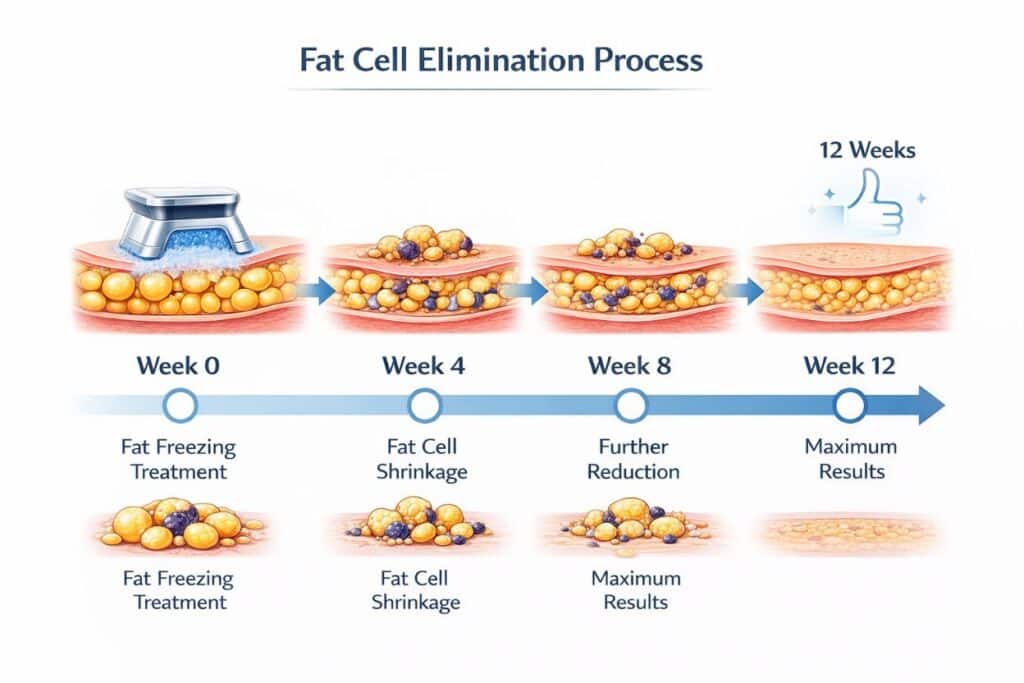
One reason some people ask does fat freezing actually work is that results are not instant. The body clears damaged fat cells gradually. Subtle changes may begin within 2 to 4 weeks, but the more visible contouring effect usually develops over 2 to 4 months. A second or third session may be recommended for certain areas or stronger results.
| Treatment aspect | Typical range |
|---|---|
| Session length per area | 35 to 75 minutes |
| Initial sensations | Tugging, cold, tingling, numbness |
| Downtime | Usually minimal |
| Visible changes | Often 2 to 4 weeks |
| Peak results | Usually 2 to 4 months |
| Common number of sessions | 1 to 3 depending on area and goals |
Benefits and limitations of fat freezing
Benefits
- Non-surgical and non-invasive, with no incisions or general anaesthetic.
- Targets localised fat pockets that may be resistant to diet and exercise.
- Minimal downtime, so most people return to normal activity the same day.
- Clinical studies support measurable fat layer reduction, often around 20% to 28% per treated area.
- Destroyed fat cells are removed by the body over time, which can support long-lasting contour changes if weight is stable.
- Suitable for several body areas including abdomen, flanks, thighs, arms and submental fat.
Considerations
- It is not a weight-loss treatment and is not appropriate for obesity management.
- Results are gradual rather than immediate, usually taking weeks to months.
- More than one session may be needed to reach the desired outcome.
- Temporary side effects such as numbness, redness, swelling, bruising or tenderness are common.
- Rare complications can occur, including paradoxical adipose hyperplasia, where the treated fat enlarges rather than shrinks.
- It is unsuitable for some people with cold-sensitivity disorders or certain medical conditions.
Fat freezing works best as a body contouring treatment for stubborn areas, not as a shortcut to overall weight loss.
Fat cell apoptosis and why it matters
The phrase fat cell apoptosis sounds technical, but the concept is straightforward. Apoptosis is a form of programmed cell death. Rather than bursting open dramatically, the cell is signalled to shut down in a controlled way. In cryolipolysis, cold exposure stresses adipocytes enough to trigger this process.
After treatment, the body mounts a mild inflammatory response in the area. Immune cells, especially macrophages, gradually digest and clear away the damaged fat cells and their contents. This is why the final result appears slowly. The body is doing the clean-up naturally over a period of weeks and months.
This mechanism is significant for two reasons. First, it helps explain why cryolipolysis can create a lasting reduction in the number of fat cells in the treated area. Second, it clarifies why the procedure is considered contouring rather than instant debulking. Unlike surgical fat removal, there is no immediate dramatic change on the day of treatment.
The idea that removed fat cells are gone permanently is broadly accurate, but it needs context. Adults generally maintain a relatively stable number of fat cells, so cells eliminated by treatment do not simply reappear in the same quantity. However, the remaining fat cells in treated and untreated areas can still enlarge if overall calorie intake exceeds expenditure. In other words, results can last well, but lifestyle still matters.
Does fat freezing actually work? What the evidence shows
On the question of does fat freezing actually work, the balance of published evidence suggests yes, for the right candidate and the right indication. Clinical studies and reviews have shown statistically significant reductions in localised fat thickness after cryolipolysis. Reports commonly cite reductions of around 20% to 25% after one session, with some literature noting figures up to 28% at around four months.
A review in PubMed (PMID: 25548084) concluded that cryolipolysis is generally safe and effective for non-invasive fat layer reduction. Clinical overviews from Cleveland Clinic and consumer health summaries linked to Harvard Health likewise present it as a recognised non-surgical option for reducing localised fat.
That said, effectiveness is not identical for every person or every body area. Outcomes depend on factors such as:
- how much treatable fat is present
- applicator fit and treatment protocol
- the thickness and composition of the tissue
- whether one or multiple sessions are carried out
- weight stability after the procedure
It is also worth separating visible improvement from perfection. Patients often notice a slimmer outline in clothing or a smoother contour rather than a dramatic transformation. Those looking for a more aggressive result may need surgery, while those mainly dealing with skin laxity may need a tightening-focused approach such as radio frequency body tightening rather than fat reduction alone.
Safety and side effects
Most side effects are temporary and mild to moderate. These can include redness, swelling, bruising, tenderness, tingling and numbness in the treated area. Some people also report temporary cramping or aching after the session. Serious complications are uncommon, but the main rare adverse effect discussed in the literature is paradoxical adipose hyperplasia, often shortened to PAH, in which the treated area becomes larger and firmer instead of smaller. If you want a detailed discussion of this specific risk, see CoolSculpting PAH risk.
Who is a good candidate for fat freezing?
Good candidates are usually adults who are near their goal weight, have realistic expectations and want to reduce a defined pocket of pinchable fat. Typical treatment areas include the abdomen, flanks, inner or outer thighs, upper arms, back, bra line and under-chin fullness.
BMI considerations and suitability
There is no universal BMI cut-off used by every clinic or device manufacturer, but cryolipolysis is generally best suited to people who are not clinically obese and who are looking for contour refinement rather than large-volume reduction. Many providers favour patients within or moderately above a healthy weight range, but suitability is ultimately assessed by body composition, the area being treated, and medical history rather than BMI alone.
If your main objective is broad weight reduction or obesity treatment, cryolipolysis is unlikely to be the most appropriate first-line option. In that situation, medically supervised nutrition, exercise support, or prescription-led services may be more suitable. Equally, if the concern is loose skin after weight loss, tightening treatments may be more relevant than fat freezing.
Who should avoid treatment?
People with certain cold-related conditions should usually not have cryolipolysis. These may include cryoglobulinaemia, cold agglutinin disease and paroxysmal cold haemoglobinuria. It may also be unsuitable in some cases of impaired circulation, active skin disease in the treatment area, hernias in the target zone, pregnancy, or where the tissue simply cannot be safely or effectively drawn into the applicator.
A proper consultation is essential. This allows a qualified clinician to determine whether the likely benefit justifies the treatment and whether another option may better fit your goals. If you are still comparing approaches, our evidence summary on does fat freezing work is a useful next read.
Conclusion: benefits, limitations and realistic expectations
So, what is fat freezing in practical terms? It is a clinically researched, non-surgical method of reducing localised fat through controlled cooling. The science of cryolipolysis is based on the greater cold sensitivity of fat cells, which leads to apoptosis and a gradual inflammatory clearance process. For suitable candidates, this can produce visible contour improvement with little downtime.
The benefits are clear: it is non-invasive, widely used, and supported by evidence showing average fat reduction in the treated area of roughly 20% to 28% after a session. The limitations are just as important: it is not a weight-loss treatment, results are gradual, and not everyone is an ideal candidate. Side effects are usually temporary, but rare complications such as PAH should form part of any informed consent discussion.
For anyone considering treatment, the most sensible next step is a consultation with an experienced provider who can assess your anatomy, goals and medical history. A reputable clinic should explain the likely outcome honestly, discuss alternatives, and avoid presenting cryolipolysis as a miracle fix. That evidence-led, balanced approach is exactly what body contouring decisions deserve.
Cryolipolysis is not about losing weight quickly; it is about selectively reducing stubborn fat with controlled cooling and realistic expectations.
Frequently Asked Questions
Does fat freezing permanently remove fat?
Fat freezing can permanently reduce the number of fat cells in the treated area because damaged adipocytes are gradually cleared by the body after apoptosis. However, permanence does not mean immunity from future weight gain. The remaining fat cells can still enlarge if body weight increases, so long-term results depend on weight stability and lifestyle habits.
How cold does fat freezing get?
Exact settings vary by device and protocol, but treatment temperatures are commonly described in the range of about 30 to 39 degrees Fahrenheit, or roughly minus 1 to 4 degrees Celsius, at the treatment interface. These temperatures are carefully controlled to target fat while protecting surrounding tissue.
Is cryolipolysis the same as CoolSculpting?
Cryolipolysis is the general medical term for fat freezing using controlled cooling. CoolSculpting is one branded system that uses cryolipolysis technology. In everyday conversation, people often use the names interchangeably, but strictly speaking, CoolSculpting is a brand and cryolipolysis is the treatment category.
How many fat freezing sessions do you need?
Many patients have between one and three sessions per area, depending on the size of the bulge, the body area involved and the desired outcome. Some people are satisfied after one session, while others choose additional treatment for a stronger contouring effect. A consultation is needed to estimate the likely number of sessions.
Can fat freezing damage organs?
When performed correctly using an approved clinical device and proper assessment, cryolipolysis is intended to affect the superficial fat layer rather than internal organs. Published clinical data and established medical sources generally describe the procedure as safe for suitable candidates. Problems are more likely when treatment is unsuitable, poorly delivered or attempted with unregulated equipment.
What is the Harvard 'popsicle' discovery?
This refers to the observation that cold exposure from ice lollies could cause temporary cheek dimples in children due to inflammation of fat, called popsicle panniculitis. That phenomenon helped inspire Harvard-affiliated researchers to explore whether local cooling could selectively reduce fat in a controlled medical setting, eventually contributing to the development of cryolipolysis.