HIFU vs Botox: the short answer
When people search for HIFU or Botox which is better, they are often assuming these treatments are direct rivals. In reality, they are usually complementary, not competitors. They target different signs of ageing, work in different ways and suit different parts of the face.
HIFU uses focused ultrasound energy to stimulate collagen and support tissue tightening over time. It is commonly chosen for mild to moderate skin laxity, softening jowls, improving jawline definition and giving a subtle non-surgical lift. Botox, by contrast, uses botulinum toxin to temporarily relax specific facial muscles, which helps smooth dynamic wrinkles such as forehead lines, frown lines and crow’s feet.
So if your main concern is sagging, heaviness around the lower face or a loss of contour, HIFU is often the better fit. If your priority is expression lines in the upper face, Botox is usually the more effective option. For many patients, the best plan is not choosing one over the other, but combining them thoughtfully.
If you are exploring broader lifting treatments, our guide to non-surgical facelift options explains where HIFU sits alongside other technologies and how a tailored plan can produce more balanced results.
Why this comparison matters
Anti-ageing treatments work best when matched to the right problem. Dynamic wrinkles are not the same as skin laxity, and jowls are not the same as forehead lines. An experienced practitioner should assess your facial movement, skin quality, collagen loss and treatment goals before recommending any plan.
That matters from both a safety and value perspective. Botox in the wrong area will not lift loose skin, and HIFU will not erase etched-in frown lines in the same way a muscle-relaxing injectable can. Understanding the difference helps you spend money more wisely and set more realistic expectations.


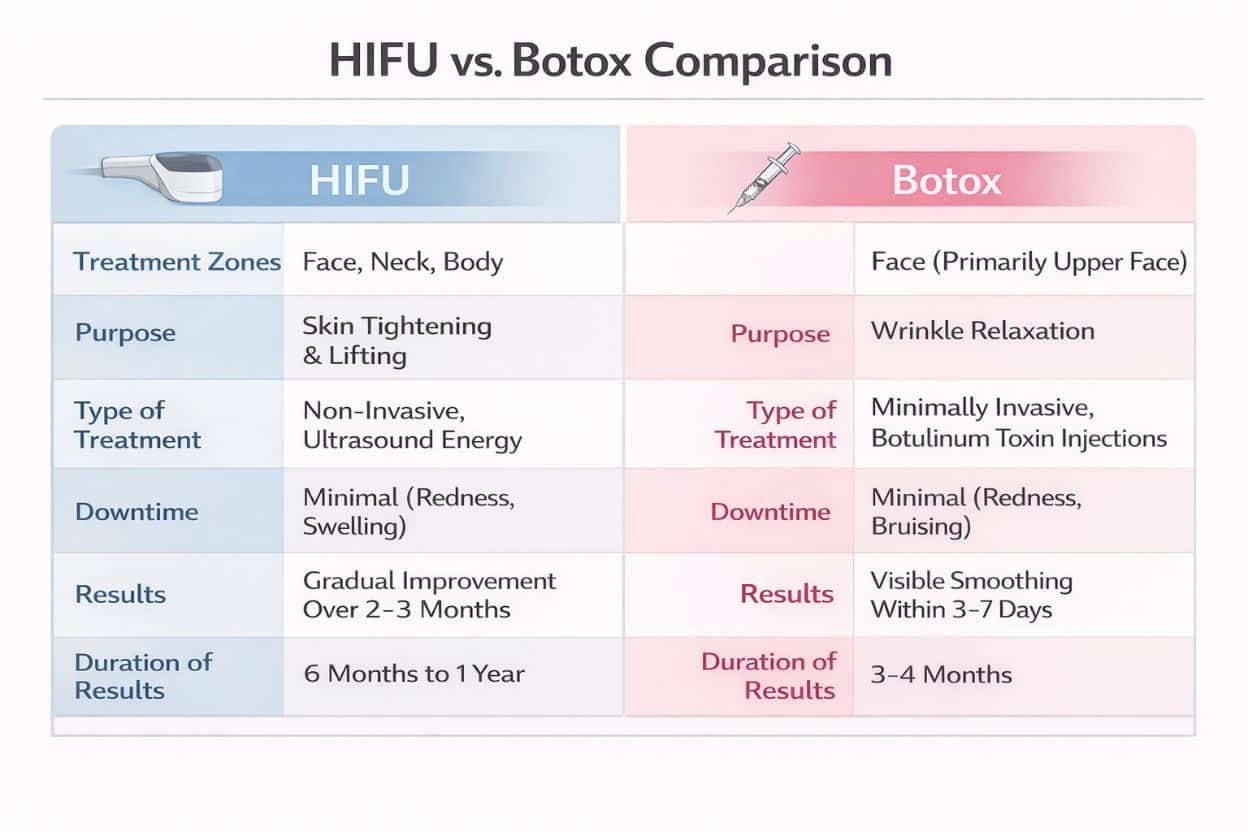
The right treatment depends on whether your main concern is wrinkles caused by movement or skin laxity and facial sagging.
How HIFU and Botox work
How HIFU works
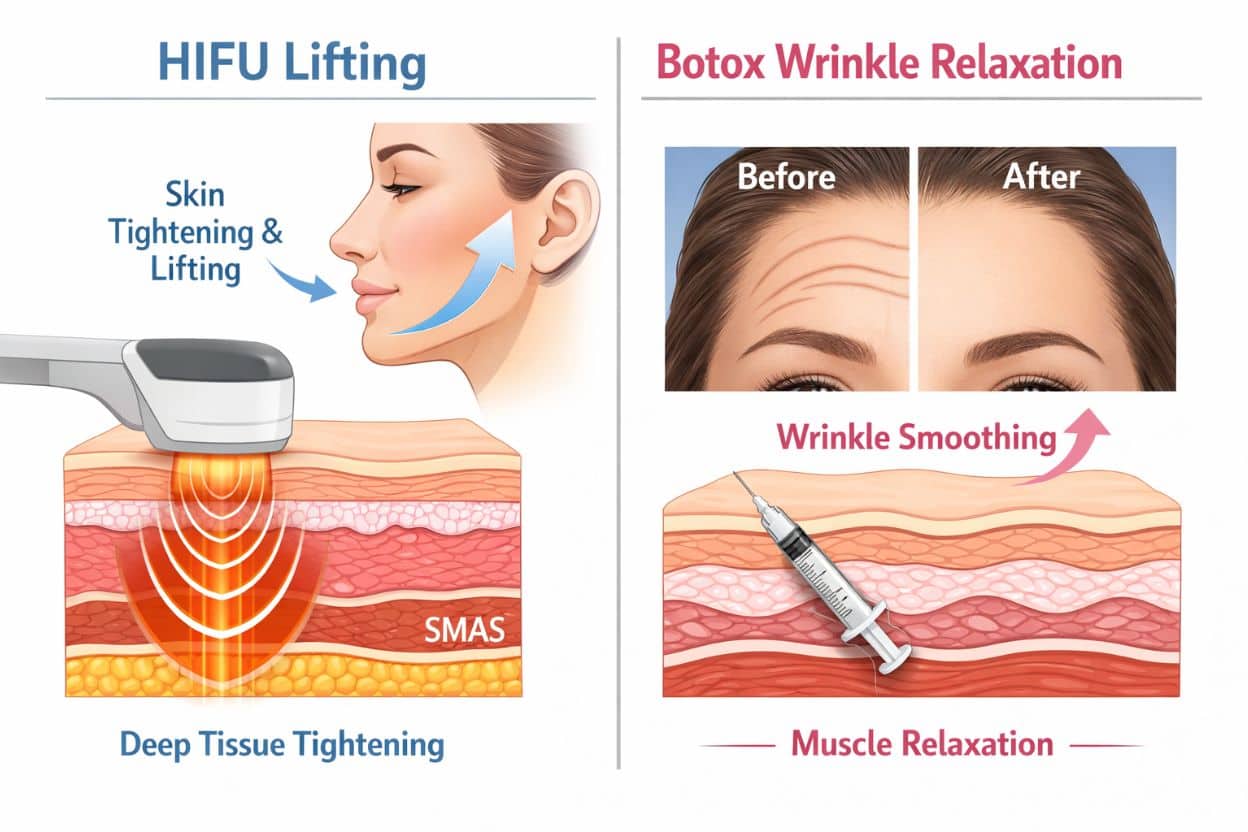
HIFU stands for high-intensity focused ultrasound. In facial aesthetics, it delivers controlled ultrasound energy into deeper structural layers of the skin, including the superficial muscular aponeurotic system, often called the SMAS layer. This is the same foundational layer addressed during surgical facelifts, but HIFU reaches it without incisions. The treatment triggers a wound-healing response that encourages new collagen formation, leading to gradual tightening and lifting over the following weeks and months.
The clinical rationale for HIFU as a skin-tightening treatment is supported by published evidence showing improvement in skin laxity and collagen remodelling in selected patients, with outcomes generally developing progressively rather than instantly. A useful overview is available via PubMed research on microfocused ultrasound for skin lifting.
Because HIFU stimulates your own tissue response rather than freezing muscles, it is best thought of as a contouring and firming treatment. It can be particularly helpful along the jawline, under the chin and around the lower face, which is why searches for HIFU vs Botox for jowls are so common. If you want to understand timing in more detail, our article on how long HIFU results last and when to expect them explains the usual treatment timeline.
How Botox works
Botox is a brand name often used generically to describe botulinum toxin type A treatments. It works by temporarily blocking the nerve signals that tell specific facial muscles to contract. When those muscles relax, the overlying skin creases less, so dynamic lines become softer. This is why Botox is so widely used for forehead lines, glabellar lines between the brows and crow’s feet.
The evidence base for botulinum toxin in facial aesthetics is extensive, and it is one of the most established non-surgical treatments in cosmetic medicine. For clinical and regulatory guidance, see the NICE evidence summary on botulinum toxin type A for glabellar lines and broader information from peer-reviewed literature such as this review on botulinum toxin in aesthetic medicine.
Botox does not stimulate collagen in the way HIFU does, and it does not physically tighten loose tissue. Instead, it reduces the muscle movement that causes certain wrinkles to deepen. That is why it excels in the upper face but is not the go-to treatment for lower-face sagging.
In simple terms
| Treatment | Main mechanism | Best for |
|---|---|---|
| HIFU | Focused ultrasound stimulates collagen and tissue tightening | Sagging, jowls, skin laxity, facial contour |
| Botox | Botulinum toxin relaxes targeted muscles | Forehead lines, crow’s feet, frown lines, dynamic wrinkles |
If your question is simply non-surgical facelift vs Botox, the answer is that a lifting treatment like HIFU aims to improve structure and firmness, whereas Botox mainly softens movement-related lines.
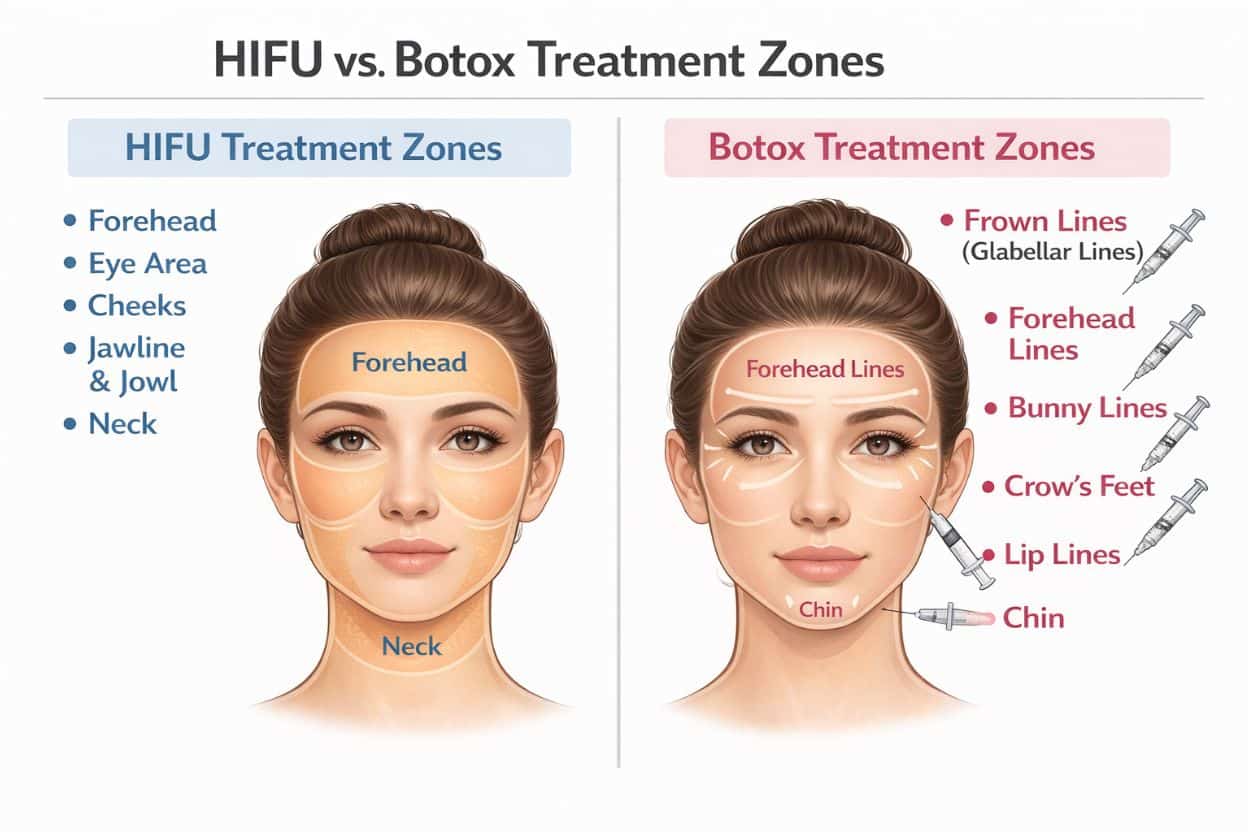
HIFU and Botox use completely different mechanisms, which is why they treat different concerns.
HIFU vs Botox: benefits and considerations
Benefits
- HIFU can improve mild to moderate skin laxity, soften jowls and refine the jawline without surgery.
- HIFU results can last around 6 to 18 months depending on age, skin quality and the area treated.
- Botox works quickly for dynamic wrinkles, with visible softening often appearing within a few days.
- Botox is highly targeted, making it effective for forehead lines, frown lines and crow’s feet.
- Both treatments involve minimal downtime and can fit around normal daily routines.
- Used together, they can address both upper-face wrinkles and lower-face laxity for a more comprehensive anti-ageing plan.
Considerations
- HIFU does not give instant results; the lift develops gradually as collagen remodels.
- HIFU is less effective for wrinkles caused mainly by facial muscle movement.
- Botox does not lift sagging tissue or improve jowls in the way HIFU can.
- Botox usually needs repeating every 3 to 4 months to maintain the effect.
- Comfort levels vary: HIFU can feel warm or prickly, while Botox involves several small injections.
- Neither treatment is a substitute for surgery where skin laxity is advanced or expectations are unrealistic.
What each treatment treats best
When HIFU is usually the better choice
HIFU tends to be the stronger option when the issue is not lines from movement but a gradual drop in tissue support. Typical concerns include:
- Early jowls
- A softer jawline
- Mild skin laxity in the lower face
- Heaviness under the chin
- Loss of firmness around the cheeks or neck
This is where the query HIFU vs Botox for jowls has a clear answer: HIFU is generally better suited to jowls because it targets laxity and collagen support. Botox may occasionally be used in selected lower-face protocols by advanced medical injectors, but it is not the primary treatment for lifting loose tissue.
People considering HIFU often want a subtle improvement that looks natural rather than dramatically altered. That makes it attractive for patients who prefer device-led treatments over injectables or who want to support facial definition without surgery. If you are comparing technologies specifically, our guide to HIFU vs Ultherapy covers another common skin-tightening question.
When Botox is usually the better choice
Botox is often the best option when wrinkles appear or deepen with expression. Typical examples include:
- Horizontal forehead lines
- Vertical frown lines between the brows
- Crow’s feet at the outer corners of the eyes
- Fine lines caused by repeated facial movement
If the lines are visible mainly when you smile, squint or frown, Botox is likely to outperform HIFU. That is because the cause is muscular action rather than loose skin. Results are also quicker, which is useful if you have an event coming up or prefer a more immediate change.
Can either treatment help the whole face?
Yes, but in different ways. HIFU can improve overall facial firmness and contour, especially in the mid and lower face. Botox can create a fresher look by smoothing key expression lines. Neither should be viewed as a universal fix for every sign of ageing. In practice, a personalised plan may also involve treatments such as microneedling or cold plasma skin rejuvenation if skin texture, acne scarring or surface quality are also concerns.
Results, longevity and downtime
How quickly will you see results?
Botox is the faster treatment. Most people start noticing improvement within 3 to 5 days, with full effect usually visible by around 10 to 14 days. HIFU is slower because it relies on biological collagen remodelling. Some people notice a mild early tightening effect, but the main improvement tends to emerge over 6 to 12 weeks.
Which lasts longer?
For most patients, HIFU lasts longer. A realistic range is around 6 to 18 months depending on your age, skin laxity, lifestyle and the treatment protocol used. Botox typically lasts around 3 to 4 months, although this varies between individuals and treatment areas.
So if you are comparing HIFU vs Botox cost, remember that price and longevity are linked. HIFU usually costs more upfront, but it often needs fewer sessions per year. At VIVO, HIFU treatments start from £99, while Botox pricing varies by area treated and the number of areas included.
What about downtime?
Both treatments are popular partly because downtime is minimal. After HIFU, you may experience temporary redness, tenderness or a slightly tight feeling, but most people return to normal activities straight away. After Botox, there may be mild redness, tiny bumps or minor bruising at injection points, but day-to-day life is rarely disrupted.
As with any cosmetic treatment, suitability, aftercare and realistic consent matter. The NHS guidance on botulinum toxin is a useful reminder that non-surgical does not mean risk-free, and treatment should always be carried out by appropriately trained professionals in a safe clinical setting.
HIFU lifts what is starting to sag; Botox softens what keeps creasing. For many faces, that is not an either-or decision.
Comfort, safety and who should choose which
Which is more painful?
Neither treatment is usually described as severe, but they feel very different. HIFU is often reported as a warm, prickling or zapping sensation as the energy is delivered at different depths. Some areas, especially around the jawline, can feel sharper than others. Botox involves a series of very small injections, so most people describe it as a quick pinching sensation.
If you dislike needles, HIFU may feel more psychologically comfortable even if the energy pulses are more intense in the moment. If you prefer a brief appointment with very fast visible results, Botox may feel easier overall.
Safety considerations
Both treatments are generally considered safe when carried out by qualified, experienced practitioners using appropriate protocols. That said, they have different risk profiles.
With HIFU, the key safety issue is correct patient selection and proper device use. It is not suitable for everyone, and results can be underwhelming if skin laxity is too advanced. With Botox, the key issues are dosing, placement and medical assessment. Done well, the aim is a refreshed look with preserved expression, not a stiff or overtreated appearance.
Published reviews support the overall safety of both modalities in trained hands, but consultation remains essential. A practitioner should take a medical history, assess contraindications and explain expected outcomes, limitations and aftercare before treatment. This is especially important for first-time patients and for anyone comparing options based on online before-and-after photos alone.
Who is usually a good candidate for HIFU?
- People noticing early to moderate facial sagging
- Patients concerned about jowls or jawline softening
- Those wanting a non-surgical lift with little to no downtime
- Individuals happy to wait for gradual results
Who is usually a good candidate for Botox?
- People with visible expression lines in the upper face
- Patients wanting relatively fast results
- Those happy to maintain results every few months
- Individuals seeking targeted wrinkle reduction rather than lift
The combination approach: often the best answer
For many patients, the most effective strategy is a combination approach. Botox can smooth the upper face, while HIFU supports lifting and tightening through the mid and lower face. This pairing can create a more balanced anti-ageing result because it addresses two different causes of facial ageing at once: muscle movement and collagen loss.
That is why experienced clinics do not usually frame the question as a strict battle of HIFU vs Botox. Instead, they assess what each treatment can contribute. Someone with forehead lines and early jowls may gain far more from using both than from over-relying on either treatment alone.
At VIVO, both options are available, and treatment plans can be tailored around your anatomy, goals and tolerance for downtime. If you are still deciding, it can also help to explore complementary reading such as what really works in non-surgical facelift treatments, as well as the dedicated pages for HIFU facelift and body tightening and Botox anti-ageing injections.
So, HIFU or Botox: which is better for you?
The honest answer is that it depends on what you are trying to treat. Choose HIFU if your priority is lifting, tightening and improving facial contour, especially around the jawline and lower face. Choose Botox if your main concern is dynamic wrinkles across the forehead, brow area or around the eyes. Choose both if you want a more comprehensive anti-ageing plan that tackles different layers of facial ageing at the same time.
Above all, avoid chasing a treatment because it is trending. The best aesthetic results come from matching the right tool to the right concern. Get expert advice on which treatment suits your concerns at your nearest VIVO studio.
A personalised consultation is the best way to decide whether HIFU, Botox or a combination is right for you.
Frequently Asked Questions
Can you have HIFU and Botox together?
Yes, many people can have HIFU and Botox as part of the same broader anti-ageing plan, because they treat different concerns. Botox is usually used to soften dynamic wrinkles such as frown lines, forehead lines and crow’s feet, while HIFU is used to improve skin laxity, contour and mild sagging.
The exact timing should be decided by your practitioner, as protocols vary depending on the areas treated and your treatment history. In general, combining upper-face wrinkle reduction with lower-face lifting can create a more complete result than relying on either treatment alone.
Which is better for jowls?
HIFU is usually the better option for jowls. That is because jowls are mainly linked to skin laxity, collagen loss and tissue descent rather than facial muscle movement. HIFU works by delivering focused ultrasound energy to deeper layers, encouraging collagen remodelling and subtle lifting over time.
Botox is not typically the first-line choice for jowls. It can be useful in selected lower-face treatment plans, but it does not tighten loose skin in the same way. If your main concern is jawline definition or early lower-face sagging, HIFU is generally the more relevant treatment.
Which lasts longer, HIFU or Botox?
HIFU usually lasts longer. Many patients see benefits for around 6 to 18 months, depending on age, skin quality, lifestyle factors and the area treated. Botox generally lasts around 3 to 4 months before muscle activity gradually returns and lines begin to reappear.
That means Botox tends to need more regular maintenance. However, it also works faster, so the better choice depends on whether you prioritise quick results or longer-lasting lifting and tightening.
Which is more painful?
Comfort is subjective, but most people say the treatments feel different rather than one being universally worse. HIFU is often described as warm, prickly or slightly sharp in bursts, particularly in bony areas such as the jawline. Botox usually feels like a series of brief pinches from very fine needles.
If you strongly dislike injections, HIFU may feel easier from a psychological point of view. If you prefer a very short treatment with fast results, Botox may feel more manageable. A good consultation should include an honest discussion about comfort and what to expect.
At what age should you switch from Botox to HIFU?
There is no fixed age when you should switch from Botox to HIFU, because the decision should be based on your concerns rather than your birthday. Some people start Botox earlier to manage dynamic lines, while HIFU becomes more relevant once skin laxity, jawline softening or early jowls appear.
In many cases, it is not a switch at all. Patients may continue Botox for upper-face wrinkles while adding HIFU later for lifting and tightening. The most effective plan is usually the one tailored to your facial movement, collagen loss and treatment goals.